

Dharampal’s Historical Reconstruction of India’s Indigenous Educational Tradition
The history of Indian education during the eighteenth and early nineteenth centuries has often been presented primarily through the later development of colonial educational institutions. Yet the historical record contains extensive evidence of educational institutions that existed across India before the consolidation of British educational policy.
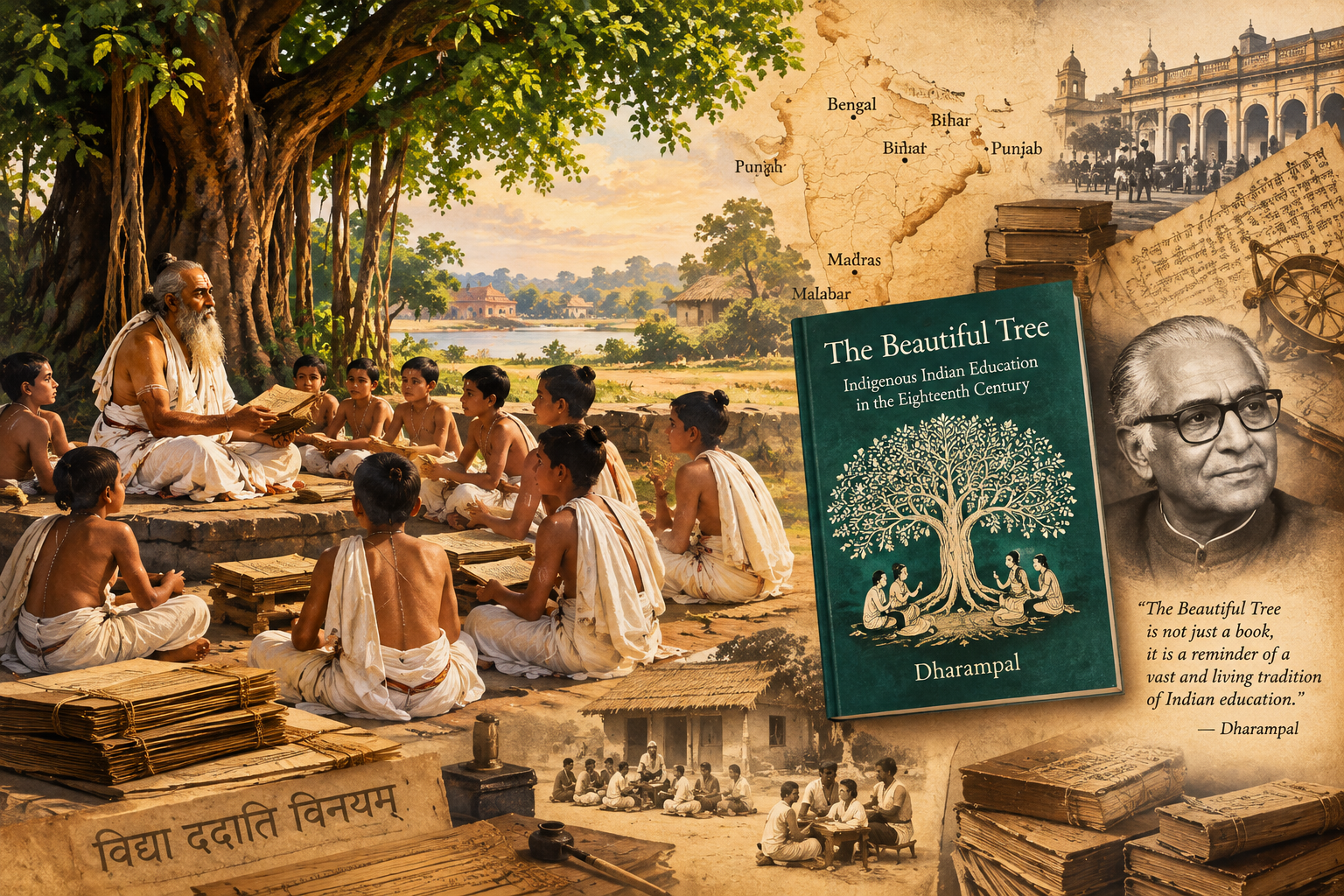
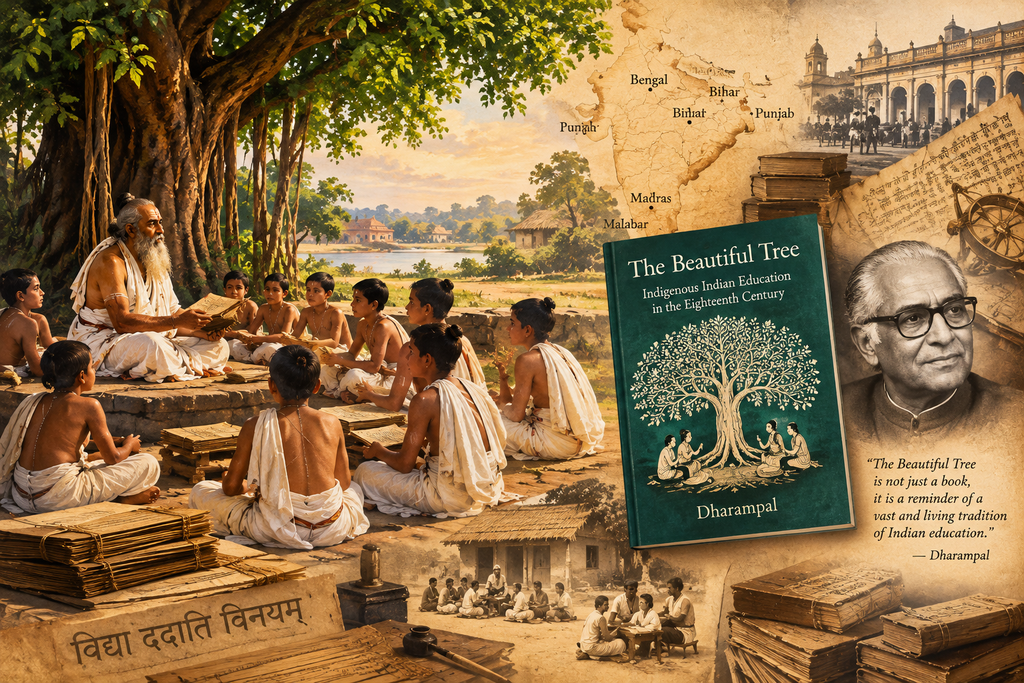
One of the most important works drawing attention to this history is Dharampal’s The Beautiful Tree: Indigenous Indian Education in the Eighteenth Century, first published in 1983. The work brings together a large body of historical documentation relating to indigenous education in different regions of India, particularly the Madras Presidency, Bengal and Bihar, Malabar and Punjab.
Dharampal’s work is significant because it does not attempt to reconstruct the history of Indian education only through later colonial policy documents or modern descriptions. Instead, it reproduces and examines a substantial body of earlier reports, surveys, correspondence and administrative records, many of which were produced by British officials themselves.
The “Beautiful Tree”
The title of the work refers to Mahatma Gandhi’s famous image of the Indian educational tradition as a “beautiful tree.” Dharampal used this expression as the title for his study of indigenous Indian education.
The central historical question is therefore not simply whether educational institutions existed in India, but what kind of educational network existed, who participated in it, what was taught, who taught, and how these institutions were connected with Indian society.
The book places particular emphasis on the extensive surveys of indigenous education undertaken in the early nineteenth century. Its documentary material includes the 1822–1826 survey of indigenous education in the Madras Presidency, material concerning education in Bengal during 1835–38, observations on Indian education by European visitors and officials, and later correspondence concerning the historical character of indigenous Indian education.
Indigenous Schools Across India
The documentary material collected by Dharampal points toward the existence of numerous indigenous educational institutions at the local level.
These institutions included village schools and centres of higher learning. Their organization varied from region to region, as did their curricula, teachers, financial arrangements and patterns of participation.
The evidence assembled in The Beautiful Tree therefore allows the history of Indian education to be examined as a diverse network rather than as a single uniform institution.
The book contains material relating to regions including Madras, Bengal, Bihar, Malabar and Punjab, allowing comparisons between different educational environments.
What Was Taught?
The indigenous educational tradition was not limited to elementary reading and writing.
The documentary material discussed by Dharampal includes learning in areas such as:
- Sanskrit grammar
- Literature and language
- Logic and philosophy
- Mathematics
- Astronomy
- Law and Dharmashastra
- Ayurveda and medicine
- Theology and religious learning
- Regional literary traditions
- Reading, writing and practical knowledge
The book also discusses institutions of higher learning and specialized forms of scholarship. Its contents specifically include material concerning higher educational institutions, Nyaya, mathematics, astronomy and Ayurveda.
This is particularly important when considering the historical meaning of education in India. Education was not necessarily separated into the modern categories of “religious” and “secular” knowledge. Different forms of intellectual, practical, philosophical and scriptural learning could exist within interconnected traditions of scholarship.
The Village School
One of the most important aspects of the evidence assembled in The Beautiful Tree concerns the village-level educational institution.
The village school formed an important part of the educational environment in many areas. Such schools could provide instruction in basic literacy and numeracy while also functioning within the social and economic life of the local community.
The evidence is especially valuable because it allows historians to investigate the actual functioning of educational institutions rather than assuming that education was absent simply because it did not resemble the later European model of schooling.
Dharampal’s documentation consequently raises an important historical question:
What did education in India actually look like before colonial educational institutions became dominant?
Education and Society
Another important feature of the work is its examination of the relationship between education and Indian society.
The school was not necessarily an isolated institution existing independently of the surrounding community. Teachers, students, families, local communities, religious institutions, landholders and other social groups could all participate in sustaining educational activity.
The documentary evidence therefore provides material for examining how education was supported and organized at the local level.
This is one reason The Beautiful Tree remains an important source for discussions of the history of Indian education: it shifts attention from educational policy alone toward the actual institutions and people who participated in learning.
Sanskrit and Higher Learning
Alongside village education, India possessed established traditions of advanced learning.
Sanskrit learning occupied an important position within several intellectual traditions. Institutions and teachers provided instruction in grammar, literature, philosophy, logic, law and other branches of knowledge.
The study of Sanskrit was not simply the acquisition of a language. For traditional scholars, Sanskrit provided access to an enormous intellectual corpus containing philosophical, theological, grammatical, literary, juridical, mathematical, astronomical and medical knowledge.
The history of institutions such as Sanskrit pāṭhaśālās and other centres of traditional learning must therefore be understood within this wider intellectual environment.
The early nineteenth-century documentation discussed by Dharampal provides important material for investigating these institutions and their scholars.
The Colonial Encounter
The educational institutions described in the documentary material existed during a period in which British political control and administrative influence were expanding rapidly.
The colonial encounter consequently produced major changes in the organization of Indian education.
British officials conducted surveys of existing institutions, investigated Indian systems of learning and gradually developed new educational policies. These developments eventually contributed to a transformation of educational institutions, curricula, languages and patterns of patronage.
Dharampal’s work is particularly concerned with bringing the earlier educational landscape into view before evaluating the changes that occurred under colonial rule.
The book therefore contains a later section dealing with British rule, the reports of Thomas Munro and William Adam, Macaulay’s educational policy, the destruction of indigenous education and the question of educational reconstruction.
The Importance of Colonial Records
One of the distinctive features of Dharampal’s method is his extensive use of colonial-era records.
The work includes documentary material generated by British administrators and observers. The collected documents include the Madras Presidency surveys of 1822–26, observations by Fra Paolino da Bartolomeo, writings attributed to Alexander Walker, William Adam’s reports on education in Bengal from 1835–38, and material concerning education in Punjab.
This documentary approach is important because the evidence comes from records produced during the period itself.
Rather than relying exclusively upon later recollections, the work places contemporary reports before the reader and allows the historical evidence to be examined in its own context.
The Beautiful Tree as a Historical Inquiry
The Beautiful Tree should therefore be read not simply as a book about schools.
It is a historical inquiry into the structure of Indian society, its institutions of learning, the relationship between education and community, and the transformation of those institutions during the period of British rule.
The book asks us to look beyond the assumption that modern educational institutions represented the beginning of organized education in India.
Its documentary approach instead opens the possibility of studying the educational systems that already existed and understanding how they functioned before, during and after the expansion of colonial administration.
Why This History Matters
The history of education is also a history of knowledge.
When an educational system changes, the change does not concern buildings and classrooms alone. It can affect:
- which languages are studied;
- which texts are considered authoritative;
- which forms of knowledge receive institutional support;
- who becomes a teacher;
- what kind of intellectual training students receive;
- how knowledge is transmitted between generations; and
- how a society understands its own intellectual heritage.
For this reason, the historical documentation collected by Dharampal is relevant not only to historians of education but also to anyone interested in India’s intellectual and cultural history.
Recovering the Educational Tradition
The significance of The Beautiful Tree lies ultimately in its invitation to recover historical evidence.
Its purpose is not merely to romanticize the past. The documentary material allows questions to be asked about the actual strengths, limitations, organization and social functioning of indigenous educational institutions.
Dharampal’s work provides a substantial documentary foundation for such inquiry.
The book’s contents demonstrate the breadth of the material he assembled: surveys of indigenous education, village schools, higher educational institutions, specialized learning, colonial reports, and correspondence concerning the history of Indian education.
The result is a picture of an educational landscape that deserves to be studied on its own historical terms.
Conclusion
The story of Indian education did not begin with the establishment of colonial schools.
Long before the development of the modern colonial educational system, India possessed numerous institutions and traditions of learning. These included village schools, Sanskrit centres, specialized institutions and systems of higher intellectual training.
Dharampal’s The Beautiful Tree: Indigenous Indian Education in the Eighteenth Century is one of the major documentary works that brings this historical question to the forefront.
First published in 1983, the book assembled extensive historical material concerning indigenous education across several regions of India and made these records available for renewed examination.
For the study of Sanskrit education, Gurukul traditions, indigenous schools and the transformation of Indian knowledge systems during the colonial period, The Beautiful Tree provides an important body of historical documentation.
Its enduring value lies in a simple but fundamental historical task:
to look carefully at the educational world that existed before asking how, why and to what extent it was transformed.
Primary Work
Dharampal, The Beautiful Tree: Indigenous Indian Education in the Eighteenth Century.
First published by Biblia Impex, New Delhi, 1983. The work contains approximately 435 pages and includes extensive documentary material and bibliographical references.
Suggested Further Reading
- Dharampal, Indian Science and Technology in the Eighteenth Century
- Dharampal, Civil Disobedience and Indian Tradition
- Dharampal, Panchayat Raj and India’s Polity
- Dharampal, Essays on Tradition, Recovery and Freedom
Dharampal’s published-works bibliography lists The Beautiful Tree among his major works and records its 1983 first publication by Biblia Impex.