
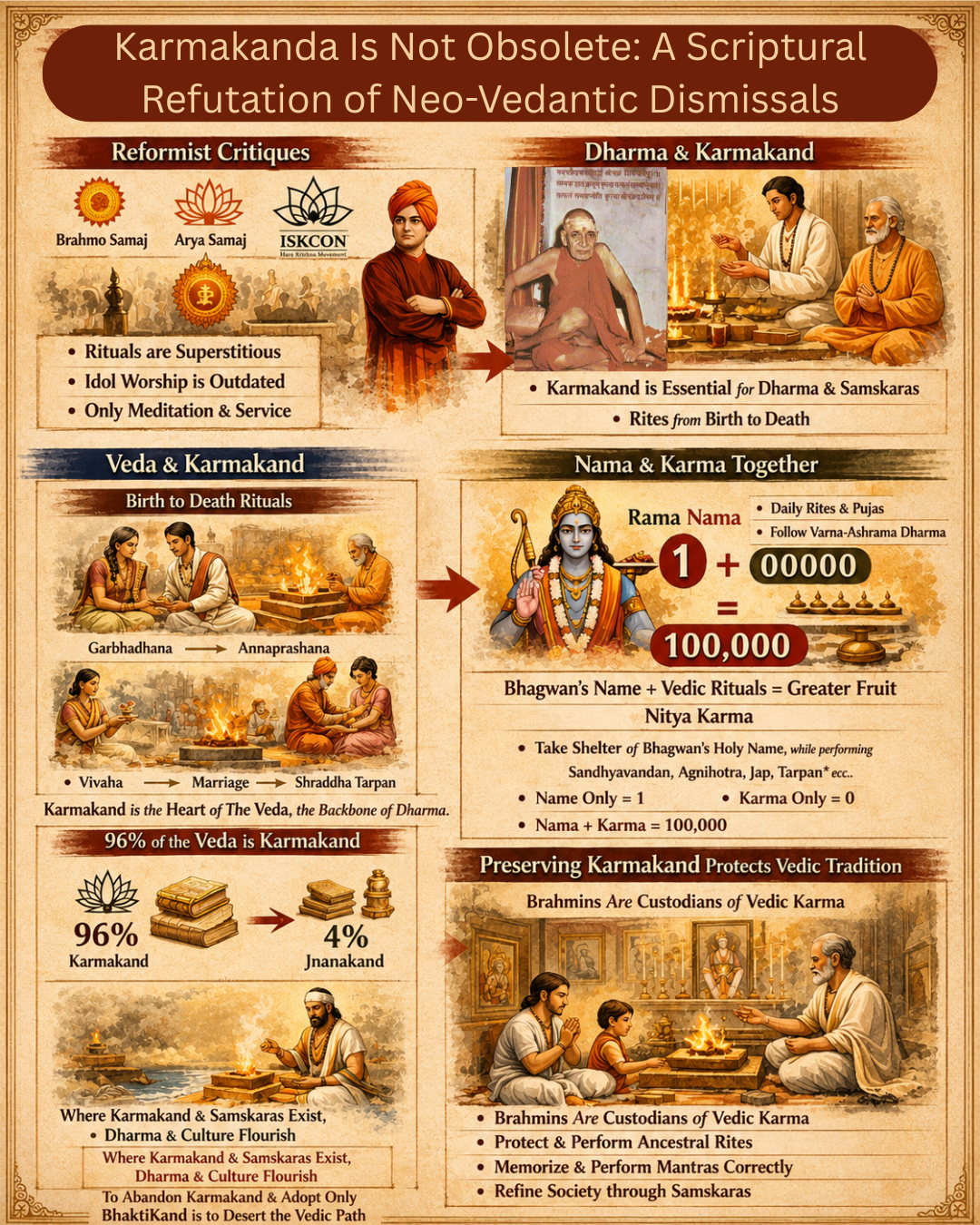

From the 1830s till today, neo-Vedāntins, and modern reformist cults—deeply influenced by British, west, missioneries and colonial critiques—have denied the necessity of karmakāṇḍa. Framing it as against true religion and contradictory or unnecessary compared to Bhagwān-nām/bhakti. They claimed that Vedic rituals, yajñas, and saṁskāras had become mechanical, caste-ridden, and superstitious, even standing in contradiction to the purity of bhakti and nāma-smaraṇa. The Brahmo Samaj and Prārthanā Samaj rejected pūjā, ritual,karmkand, śrāddh, and idol worship, teaching prayer to a formless God instead. The Arya Samaj went further, abolishing all rituals except a simplified avedic havan, and denouncing śrāddh and temple rites as wasteful superstition. Vivekananda and the Ramakrishna Mission redefined devotion as meditation, service, and inner realization rather than ritual observance/karmakand as true religion. Later, Sri Aurobindo, Osho, Theosophy, and other spiritual movements dismissed ritual entirely as a lower stage, teaching that yoga or self-realization made it redundant. Chinmaya Mission emphasized Advaita study, minimizing rites and treating karmakāṇḍa as unnecessary for Vedānta practice.
ISKCON emphasizes nāma-saṅkīrtana as supreme, while Gayatri Parivar, Brahma Kumaris, Shivanand swami, New age satsang movements, Art of Living, Isha Foundation all simplify or discard rituals in favor of collective meditation, service, or yoga. Thinkers like Savarkar openly called ritual bondage, while Golwalkar placed it below social duty. RSS people don’t perform any karmakand; instead, they eat anywhere, marry anyone, do parades with sticks, play kabaddi, and host flags, instead of following their kulparampara and the karmakand associated with it.
Wherever and to whatever extent karmakāṇḍa (the ritual aspect of Dharma) is alive, Dharma itself is alive to that extent. Without the karmakāṇḍa prescribed by varṇa and āśrama, there can be no saṁskāras (sacraments); without saṁskāras, the very idea of culture cannot exist. And without both, how can one be called a Sanātanī or a Hindu at all!? Therefore, for the protection of Dharma, it is very necessary that every family and every individual be refined and nurtured through karmakāṇḍa.
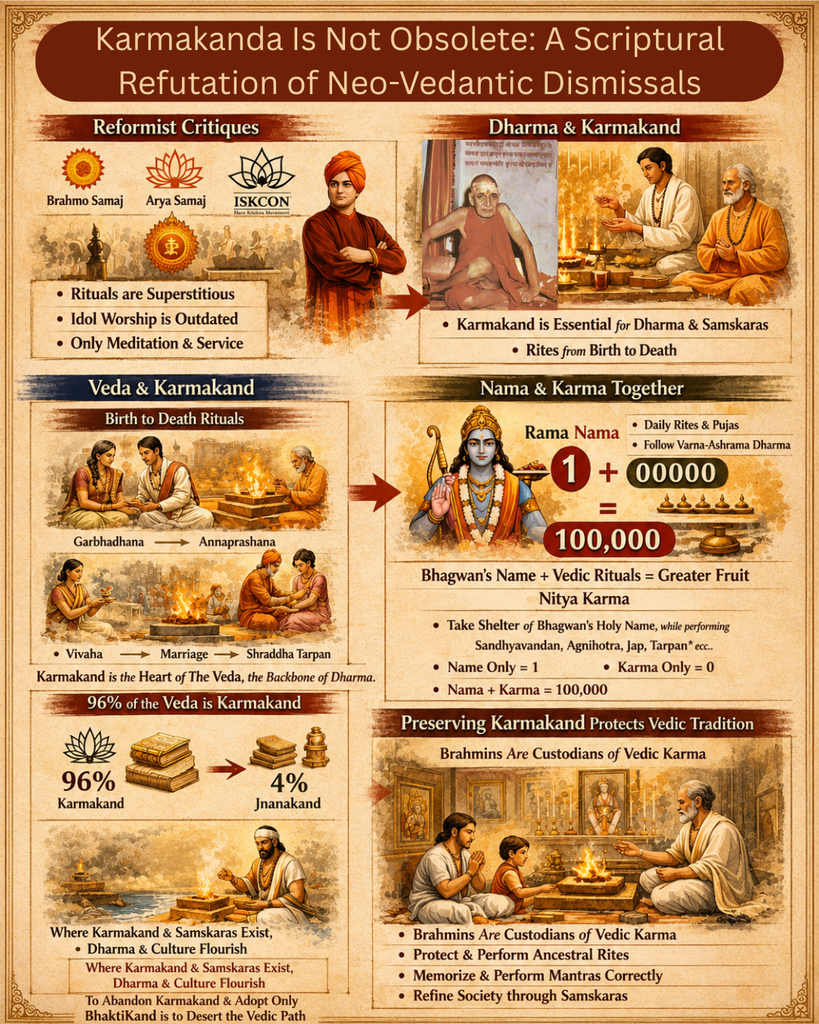
96% of the Veda (Mantra + Brāhmaṇa portions) is based on Karmakāṇḍa, and Jñānakāṇḍa is only 4%, yet even there injunctions like “कुर्वन्नेवेह कर्माणि”, “योगिनः कर्म कुर्वन्ति” emphasize the indispensability of Karma. From birth to death and even after (from Garbhādhāna to Śrāddha), every Saṁskāra is accomplished through Karmakāṇḍa, and without Karmakāṇḍa, Dharma, culture, and tradition become void. Even Vyākaraṇa has the purpose of protecting the Veda – “रक्षार्थं वेदानामध्येयम् व्याकरणम्”।, and true preservation of the Veda is done by Karmakāṇḍa scholars, not merely by those who recite a few verses or give lectures. Memorizing a few ślokas is easy, but correctly performing Śrāddha, Pārvaṇa, Sapiṇḍī etc. is difficult, and this is the true test of scholarship. Karmakāṇḍa Brāhmaṇas connect society with Saṁskāras from birth to death, and without them, society will become inactive, adharmic, and devoid of culture. Bhakti and Bhagavannāma are important, but for a janmana Brahman they cannot replace Nityakarma (Sandhyā, Yajña, Tarpaṇa, etc.), and Shastras states the same – when Karma is joined with Nāma, the sādhana becomes tenfold fruitful: राम नाम इक अंक है, सब साधन हैं शून्य। अंक रहे दस गून है, अंक गये सब शून्य।।- राम नाम is one, and all other karmas are zero. Without Bhagwan’s name, karmas have no value; but with Bhagwan’s name, when aligned with karmas, their value increases—like adding zeroes. If only Surya Argha, Sandhyavandan, etc. minimum nityakarm are performed with bhagwan naam- the value will be one lakh. If only Bhagwan’s name is taken, the value will be one. And if all śāstrokta karmakāṇḍas are performed without Bhagwan’s name, even a crore’s value becomes worthless due to the absence of the digit ‘1’ at the beginning. When performing all karmas—śāstrokt karmas such as Surya Argha, Sandhyavandan, Agnihotra, Panchabhūta Yajña, Baliveshṛava, Śrāddh-Tarpan, Dev-Rishi Tarpan, Dev-Upāsanā, your nitya (daily duties) like Sandhyavandan, and naimittika (occasional duties), prāyaścitta, nitya homa/havana, etc.—together with Bhagwan naam, they lead to the value of one crore. Therefore, both karmakāṇḍa and Bhagwan’s name are mandatory and complementary. Śāstrokta karmakāṇḍa is in complete harmony with Bhagwan’s name.
Chanting and singing the holy name (bhagwan-nāma-japa-kīrtana) is fruitful only when done free from nāmaparādha (10 offenses/dharm-adharm/vidhi-nisedh). Among the ten, three are crucial to avoid: (1)अश्रद्धा श्रुतिशास्त्रदैशिकगिरां disregarding the authority of the Vedas, scriptures, and saints, (2)विहितत्यागौ neglecting prescribed duties like sandhyā, pūjā, tarpaṇa by thinking “I only do nāma-japa,” and (3)धर्मान्तरैः साम्यं equating the holy name with other pious acts, whereas no yajña or tīrtha equals the power of nāma. Therefore, one must take shelter of the divine name while also faithfully performing one’s varṇāśrama duties—sandhyāvandana, agnihotra, devapūjā, śāstra study, pitṛ-tarpaṇa, etc. The holy name is Bhagwan Himself—through nāma one realizes God. A true devotee should perform all actions for the pleasure of the Lord.
Śrautasūtra, Gṛhyasūtra, Dharmasūtra, and Pariśiṣṭasūtra alone define the life-path, and even a Mokṣa-seeking Brahman cannot abandon Nitya and Naimittika Karmas – “नित्य-नैमित्तिके कुर्यात् प्रत्यवायजिहासया” (कुमारिल भट्ट)।. Yajña is the life of the universe – “यज्ञो विश्वस्य जीवनम्”।, and destruction of Karmakāṇḍa means destruction of creation, while protection of Karmakāṇḍa means protection of creation. Every Brahman must follow Karmakāṇḍa according to his family tradition, and to abandon Vedic Karma and adopt only Bhaktikāṇḍa is to desert the Vedic path. Thus Karmakāṇḍa is the very heart of the Veda, the backbone of Dharma and culture, and the lifeline of society, and the foremost duty of Brāhmaṇas is to practice and preserve pure Karmakāṇḍa according to their family traditions.
“ब्राह्मणानामुपासिता” — Ram and Krishna worship karmanisṭha karmakāṇḍī brāhmaṇas- not critics of Vedic rituals. Even in marriage or śrāddh, learned ritual priests are honored, not mere performers. “विप्रैः संवर्द्धितो विष्णुर्जपहोमार्चनादिभिः। भगवद्रक्षका एते वीरा एव न संशयः॥”~Through japa, homa, and arcana by Veda-knowing brāhmaṇas, Lord Viṣṇu is sustained; such brāhmaṇas are true vīras. “बलं विष्णो: प्रवर्द्धताम्”!- Protect Brahmin households for Viṣṇu’s strength; families without śrāddha, tarpaṇa, or pitṛ-karmas are destroyed. Upaniṣads are knowledge-centered and do not replace rituals, but their karmakāṇḍa-relevant teachings should be followed by smārta gṛhastha brāhmaṇas, just as householder adopts sannyāsin’s guidance when beneficial.
For countless births, even great sages strive, yet at the final moment Rām-nām does not come from the mouth जन्म जन्म मुनि जतनु कराहीं। अंत राम कहि आवत नाहीं॥ जासु नाम बल संकर कासी। देत सबहि सम गति अबिनासी॥. Jatāyu, died in the very embrace of Lord Rām. Still, Lord Rām performed the śrāddh for Jatāyu. So our īṣṭas themselves instructed and performed śrāddha— Lord Nṛsiṃha commanded Prahlāda, Lord Śrī Rāma commanded Sugrīva, Aṅgada, and Vibhīṣaṇa. Therefore, even those devoted to God must act according to the Dharmaśāstras—offering the proper rites (piṇḍa-dāna, śrāddha) and following karmakāṇḍa.
ज्योतिषं कर्मकाण्डं वा चेन्नार्हन्ति भिषग्वरा:। कृतान्तादप्यतिक्रूरा धनधर्मासुहारिण:।।- Even great physicians, if they do not respectively get alligned with astrology, karmakāṇḍa, etc., in treating patients, than they commit cruelty surpassing even Yamarāja in stealing wealth, dharma, and life.
According to Veda deities, integrated Ayurveda (“विप्र: स उच्यते भिषक्”, Śukla Yajurveda Mādhyangini Saṃhitā 12.80) can only be established in truly dharmic, disciplined Brahmins. Others may gain fame or wealth by publishing collections, setting up modern hospitals, but the true manifestation of Ayurvedic practice is only as intended by the Lord. The Soma deity governs medicines, and “सोमोऽस्माकं ब्राह्मणानां राजा” — understand this as the secret of Brahmins’ mastery.
Astrological, ritualistic, and Tantric methods are vital for treating incurable diseases; not everyone can perform these. Jyotiṣa, karmakāṇḍa, and tantra are major branches of Ayurveda.
In the Charaka Samhita, Chikitsasthana, it is stated — “अन्नाभिलाषमरोचकाविपाकपरीतं पितृभिरुन्मत्तं विद्यात्” which means: if someone has a strong desire to eat food but experiences dislike or digestive problems, it indicates they are afflicted by Pitṛ-śoka or Pitṛ-dosha; the physician should motivate such a patient to perform Pitṛ-śrāddha.
According to Sushruta Samhita— “प्रेतेभ्यो विसृजति संस्तरेषु पिण्डान् तद्भक्तो भवति पितृग्रहाभिभूत:” a competent physician, for a patient afflicted by Pitṛ-graha(ancestral affliction), should encourage Piṇḍadāna on aṣṭṛitakuśas along with other treatments.
In hundreds of such cases, Ayurveda has extensively used Karma-kāṇḍa, Jyotiṣa, and Tantra for treating Pitṛ-graha-abhihuta, Deva-graha-abhihuta, and Asura-graha-abhihuta conditions. Therefore, physicians themselves should be experts in these fields or maintain close association with such specialists.
विप्र: स उच्यते भिषक्” (शुक्लयजुर्वेदमाध्यन्दिनसंहिता १२।८०)- According to the Vedas, only a noble Brāhmaṇa firmly established in his own dharma can truly embody the complete science of Āyurveda.
If astrologers or Karma-kāṇḍa practitioners lack Ayurveda knowledge, they cannot properly understand the science of ablutions or the use of specific medicated waters in yajñas for curing specific diseases. According to Vāyu Purāṇa, a Vipra (priest) without knowledge of Jyotiṣa has no authority to perform Karma-kāṇḍa, and an astrologer without knowledge of Karma-kāṇḍa can never successfully treat anyone(grahdosh etc). Diseases arising under certain nakṣatras may be incurable, and those under others may be curable; the physician must understand this through Jyotiṣa and accordingly administer treatment for proper results.
The greater the fall from virtue or the more impure the conduct, the more the mind will be tainted by deceit, hypocrisy, attachment, and hatred. As a result, there will be maturity in the tendency to see divisions in the world. The problem lies within.
What is the goal? To realize the entire universe as Brahman. … From where will equanimity towards all arise? … Now, do you understand the importance of rituals (karmakāṇḍa) and pure conduct? Why should one practice them? Because he who perceives multiplicity in this world will attain death again through death. … Closing the eyes does not mean control over “seeing”! This is the discernment between the seer and the seen (dṛg-dṛśya-viveka). If this much is understood, then the goal should already be determined. If one hides petty or ignoble intentions within, how will impartiality towards all beings arise? Bitter it may be, but this is the truth. The very nature of existence is spirituality.
When life is not lived according to the path of the scriptures, then the structure of society and of the nation collapses, and every individual is compelled to become an asura. And who else but the scriptures can save us from being asuras! Flowing in the current of body-identity (dehātma-vāda), this world will turn into a hell, inhabited only by hellish beings. Such hellish beings will appear even as husbands, wives, parents, and children. So following karmakāṇḍa and virtue keeps society dharmic, families pure, and individuals progressing toward realization of Brahman. Ignoring them leads to asuric (hellish) life.
The Vedic system of Karmakāṇḍa is the very foundation of creation. It is that sacred institution whose complete protection prompts the Lord Himself to incarnate. The Supreme Lord Viṣṇu does not descend primarily to safeguard the businesses of merchants or the kingdoms of rulers; rather, whenever Brāhmaṇahood and Vedic Karmakāṇḍa decline, He incarnates age after age to protect them. This is because the preservation of Brāhmaṇahood ensures the preservation of Vedic Dharma, under which the distinctions of Varṇa and Āśrama are established. Adi Shankaracharyaji on Bhagwat Gītā states—“By protecting Brāhminhood, Vedic Dharma is protected, since Varṇa and Āśrama depend on it.”ब्राह्मणत्वस्य हि रक्षणेन रक्षितः स्याद वैदिको धर्मःतदधीनत्वाद वर्णाश्रमभेदानाम्।”
Therefore, one should not neglect the eternal Smārta tradition, the Brāhmaṇas, or the Vedic system of Karmakāṇḍa. Relying solely on Bhagavannāma while abandoning the scripturally prescribed Karmakāṇḍa (Ācāra) ordained for Hindus living within the Varṇāśrama system is not proper according to this traditional understanding.
O Mahādeva! We are the inhabitants of that land, nourished by the Vedas, where even parrots born in the houses of Brahmins—if they mispronounced a single syllable of the Yajurveda or Sāmaveda—students were immediately corrected or stopped mid-recitation—because the elders feared the students might pick up that mistake.: निगृह्यमाणा वटवः पदे पदे यजूंषि सामानि च यस्य शङ्किता:।”००० (कादम्बरी बाणभट्ट)
Dharm is that which is established by Śruti, Smṛti, Purāṇa, Ācāra and Sadācāra, and which is beneficial both for society and for the soul. The knowledge of Dharma should be asked only from those who have properly studied their own Veda-śākhā texts (Saṁhitā, Brāhmaṇa, Āraṇyaka, Upaniṣad, Śrautasūtra, Gṛhyasūtra, Dharmasūtra, Prātiśākhya, etc.), who are learned in Vedāṅgas (Vyākaraṇa, Nirukta, Chandas, Jyotiṣa, etc.), who are Ācāranishṭha, Sadācārī, faultless Gṛhastha Brāhmaṇas and who traditionally practice Karmakāṇḍa, and who also have an understanding of Vedānta (Bādarāyaṇīya Brahmasūtra) and Dharma-Mīmāṁsā (Jaiminīya Sūtra). This is because Dharma does not proceed merely by emotion, but by Vidhi (scriptural injunction). As Shastras say, for a Śūdra only Nāmajapa can be beneficial, but for one born in a Brāhmaṇ lineage, the Vedavihita Karmas (Sandhyā, Yajña, etc.) are compulsory. Nāmajapa and Bhakti are indeed most powerful means, but neglecting Nityānuṣṭhānas under their shelter is counted as Nāmaparādh.
भागवत पुराण (११.२०.८) states तावत् कर्माणि कुर्वीत त निर्विद्येत यावता । मत्कथा-श्रवणादौ वा श्रद्धा यावन्न जायते ॥- Until faith arises in the bhagwat katha-naam, one should continue performing ritualistic duties (karmakāṇḍa). Once faith is awakened, the path of the Guru is surely attained.
When the Lord beheld the people — immersed in worldly pleasures, charming only in appearance like mallikā (jasmine) flowers blooming in autumn, yet shrouded in the darkness of ignorance — He desired to engage in divine play (ramana) with them. But when Bhagwan wished to sport in the forest of the ignorant heart, in order to make it a worthy field for His divine play, the moon of Vedic Śrauta–Smārta Dharma arose in the sky of their hearts.
For, until the mind is purified through the observance of one’s varṇāśrama-dharma, it cannot become a fit ground for the Lord’s divine sport. The practice of Vedic rites and duties (Śrauta–Smārta karma) is the primary means of inner purification. Just as the moonrise makes the Vṛndāvana forest fit for the divine play of Bhagavān, similarly, the faithful performance of Vedic duties makes the human heart a dwelling-place for God’s presence.
By the Bhagvadārtha Anuṣṭhān of Vedic Swavarnashram Dharm, one attains the sādhan-chatuṣṭhaya — the fourfold qualifications that make one fit for Brahma-jñāna. Pashvik kāmya karma gyan — action and knowledge driven by one’s own desires — is mṛityu(pashuwat jivan like waking 10 am,not doing sandhya etc). Therefore, through avidyā(Vedic kāmya karma gyan) one transcends pāśvika kāmya karma gyan-means one transcends death; and through vidyā (brahma-vidyā), one attains immortality (amṛitatva). As the Veda declares: अविद्यया मृत्युं तीर्था विद्ययामृतं अश्नुते — by avidya, one crosses death; by vidyā, one attains immortality. Just as one knot is undone by another, one knowledge, action, and desire must replace another: rising at Brahma-muhurta, performing homa, bathing, doing Sandhyā-vandana, offering Sūryārgha and Agnihotra — these Śrauta–Smārta duties purify mind and senses, overcoming pāśvika impulses such as late rising, neglect of Sandhyā, uncontrolled eating, idle talk, and wrong study. Only through such scriptural discipline can the mind and senses be purified, leading to liberation. As the Bhagvad Gītā states: स्वकर्मणा तमभ्यर्च्य सिद्धिं विन्दति मानवः — by worshipping the Lord through prescribed duties, man attains perfection. Śrīmad Bhāgavatam (11.14.45–46) teaches: नाचरेद्यस्तु वेदोक्तं स्वयमज्ञोऽजितेन्द्रियः विकर्मणा ह्यधर्मेण मृत्योर्मृत्युमुपैति सः ॥ वेदोक्तमेव कुर्वाणो निःसंगोऽर्पितमीश्वरः नैष्कर्म्यां लभते सिद्धिं रोचनार्था फलश्रुतिः ॥ — he who neglects his Vedic duties falls again into death, but he who performs them selflessly attains purity of heart, freedom from bondage, Brahma-jñāna, and oneness with the Divine. The Vedas speak of rewards (heaven, progeny, wealth) only as incentives — like a mother tempting her child with sweets so he takes bitter medicine — the real fruit being inner purification and Divine realization from following karmkand. Thus, through disciplined Vedic living, man transcends pāśvika karma and only then will one qualifies for the supreme state of immortality — Brahma-jñāna(shudh antahkaran=shudh gyan)
Vedic Karmakāṇḍa is like the first step of a ladder or like school classes (10th/12th); without passing through it, one cannot enter university or reach graduation. Just as you cannot jump to the tenth step of a staircase without climbing the first, you cannot skip Karmakāṇḍa on the path to brahma-gyan.
If you jump directly to listening to Brahma Vidya, nothing will happen — your karmas will not be burnt, and you will not attain Tattva Gyan, because you are not Sādhana Chatuṣṭaya-sampanna, which is achieved only by following one’s own Swadharma. The only path to mokṣha is the one revealed by the Vedas (sruti). No other way (nānyaḥ panthā) can lead the jīva to the supreme goal(Yajurveda 31.18)- Nānyaḥ panthā vidyate’yanāya- There is no other path(modern religions etc) to transcend death than the Vedic knowledge of Brahman)
Only Veda (no other path — nānya panthā) ➔ Bhagvad-artha Swavarnashram Karmānushṭhāna (Karmkand) ➔ Bhakti (Upasnakand) ➔ Antaḥkaraṇa-śuddhi + Sādhana Chatuṣṭaya-sampann(becoming an adhikārī in Brahma-jñāna) ➔ Śuddha-jñāna (Gyankand) in shudh antahkaran➔ leading to Brahma-jñāna ➔ TATVA GYAN
The glory of the divine name (Bhagwannam) is extensively praised in the scriptures. Even a son’s call to his father can grant liberation (Ajāmila), so the power of invoking God’s name through remembrance, chanting, and hearing is immense. The Ṛigved (8.11.5) “मर्ता अमर्त्यस्य ते भूरि नाम मनामहे। विप्रासो जातवेदसः।।” affirms that mortal beings revere the countless names of the immortal Lord above even sacrifices and austerities.
Though chanting Bhagavannāma purifies one spiritually, prāyaścitta (scriptural atonement) remains necessary for social and ritual propriety. If name-chanting alone were accepted for expiation, it might lead to moral laxity — which is, in itself, an offense against the name (nāmāparādha). Hence, even devotees of the Bhāgavata tradition follow scriptural rites such as prāyaścitta and vratas. For example, Balrām underwent ritual atonement after killing Sutji(brahmahatya), following the advice of sages.
Scriptures like the Bhāgavatam declare that chanting the Lord’s name can purify even a Chāṇḍāla, making them fit for Vedic rituals. However, the use of the word “sadyah” means within 2–3 janmas he will be born as dvija, not an instant entitlement to Vedic study in the current birth.
Statements like “नाहं वेदैर्न तपसा न दानेन न चेज्यया… न कर्मणा न प्रजया धनेन त्यागेनैके अमृतत्वमानशुः” do not denigrate the Vedas or karma, but emphasize the futility of Godless ritualism. The Īśopaniṣad teaches the balance between action and knowledge: विद्यां चाविद्यां च यस्तद्वेदोभयं सह अविद्यया मृत्युं तीर्त्वा विद्ययामृतमश्नुते — He who knows both vidyā and avidyā crosses over death and attains immortality.
Similarly, the Bhagvad Gītā (e.g., 15.15) and Upaniṣads highlight that all Vedic knowledge aims at realization of the Supreme Lord. Mere karma without devotion is like sailing in an unsteady boat across the ocean of existence. The Vedic system never negates righteous action (karma), but insists that only God-centered actions bear true fruit. “राम नाम इक अंक है, सब साधन हैं शून्य। अंक रहे दस गून है, अंक गये सब शून्य।।“ — Rām-nām is like the numeral one; all other practices are like zeros. Without the one, the zeros have no value.
“नामसङ्कीर्तनं यस्य सर्वपापप्रणाशनम्। प्रणामो दुःखशमनस्तं नमामि हरिं परम्।।” — Nāmasaṅkīrtana destroys all sins, bowing to Him removes all sorrow—unto that Supreme Hari, I offer obeisance. Even a momentary remembrance of God purifies great sinners like a blazing fire burning straw. Even one vidhi-purvak Ganga snan prevents hellish births for a year. Every step toward Gangā yields the merit of an Ashvamedha Yajna.Even calling her name burns infinite paap of infinite janmas, though paap vritti doesn’t finishes that’s why shastrokt prayaschitt are necessary for antahkaran shudhi to restrain our mann to involve in paap karm in future.
Still, social norms and external purification (as per Brahmasūtra 3.4.43 “न बहिस्तूभयथापि स्मृतेराचाराच्च।”) require traditional rites. If one abandons niṣṭhā-dharma (firm religious vows), their fall requires ritual expiation, and their participation in society may be restricted.
Thus, the Vedas, Upaniṣads, Smṛtis, and Bhakti scriptures all point to an integrated approach: devotion (bhakti), remembrance of the Lord, scriptural actions (karma), austerity (tapas), charity, study, and vows together aid in attaining God. There is no contradiction, but deep harmony.
In essence, Bhakti, Upāsanākāṇḍa, Jñānakāṇḍa, Vedānta, Bhagavannāma, and Śāstric Karmakāṇḍa are not contradictory; rather, they are complementary—with Bhagavannāma, Bhakti, Upāsanā, Jñāna, and Vedāntic anusandhāna forming the heart, and Śāstric Karmakāṇḍa as the indispensable foundation that preserves, nourishes, and sustains them.